Sister Paula Gonzalez, SC, Ph.D., is nicknamed the “solar nun.” 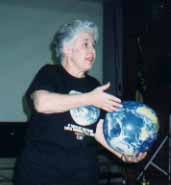
Sister Paula, 78, earned her doctorate in biology at the Catholic University in Washington, DC and was a biology professor at the College of Mt. St. Joseph in Cincinnati, Ohio for 21 years. She entered the Sisters of Charity of Cincinnati in 1954.
After learning about solar energy more than 20 years ago, Gonzalez designed and did much of the work in converting a former chicken coop to an apartment she shares with another nun. “Casa del Sol,” is a 1500 foot super-insulated, passive solar house built with recycled materials. She also renovated a building on campus that is heated in the winter entirely by solar and geothermal energy.
The first Earth Day in 1970 inspired Sister Paula to think seriously about energy and environmental issues and about how to incorporate them into her biology classes at Mt. St. Joseph. Later, when a proposed nuclear plant received strong opposition, she realized that resistance alone can not solve energy problems - or any problem for that matter. It is also vital to develop creative, life-sustaining alternatives. She firmly believes: “We have to reach the moral cores of people, as well as their brains.”
The American Solar Energy Society’s Ohio Chapter, Green Energy Ohio, gave Sister Paula their Lifetime Achievement Award in 2005.
Sr. Janet Corcoran, vice president of mission service at Marian Medical Center in Santa Clara, CA, is just one of the Catholic voices spreading the gospel that bottled water, however convenient, is environmentally, economically and politically wrong. “It’s a matter of getting people to think more consciously about what they are doing,” she said. Her column, “Environmental Tips from a Green Franciscan Sister” is published in a hospital publication.
Concerns about bottled water are bubbling up in Catholic organizations, adding clout to a growing number of municipalities and secular organizations concerned about the issue-with women religious strongly in the lead.
Numerous women’s religious communities are banning bottled water at their motherhouses, retreat houses and conference centers, and some are substituting refillable water bottles for the throw-away kind at sponsored events.
Bottled water has become a lighting rod for several environmental-social justice issues surrounding water. 
There is a negative environmental impact of discarded plastic bottles. I see plenty of those on the beach-used and left by fishermen (both native born and Spanish-speaking immigrants) to wash out into the ocean. There is the oil used to make plastic bottles. And lastly, the prize of the ownership and access to good water, especially for developing countries. Like energy resources-oil, gas, coal-water is now being privatized by corporations.
The United Nations estimates that more than 1 billion people currently lack access to safe drinking water and that by 2025 two-thirds of the world’s population will not have access to drinking water.
Some Catholic groups have borrowed information and ideas from Think Outside the Bottle, a major non-religious player in the anti-bottled water movement.
The organization has launched a web-based campaign that provides information and support. In addition to inviting individuals to sign a pledge to boycott bottled water, the program urges people to send postcards to corporations challenging corporate control of water, to attend stockholders’ meetings and mount other forms of pressure on corporate executives.
I guess what this means for me is to stop buying Poland Spring at Staples or the supermarket, and fill the empties with tap water.
I love Poland Spring. It’s easy to tote to the gym or have in the car. Water in refillable plastic bottles tastes vile. This is going to be a tough one.
Catholics are prominently featured in a new Sierra Club book, Faith in Action: Communities of Faith Bring Hope for the Planet. The book highlights faith-led environmental action in each of the 50 states plus Puerto Rico and Washington, DC. 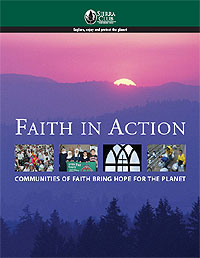
Don Conklin and Ellen Buelow, members of Holy Rosary Parish in Albuquerque, NM, helped engineer a light-bulb swap-incandescent bulbs for energy-saving compact flurorescent bulbs. Before the program was over, 3,000 bulbs changed hands.
“We did this as a Lenten project,” said Conklin, a pastoral associate at the 2,700-household parish. “And it didn’t cost us a thing. It was sponsored by the Sierra Club and PNM,” the electric company serving the Albuquerque area.
The bulbs were distributed during an annual parish awareness weekend. “We’re planning our next awareness weekend and we’re coming up with the theme of helping families,” Buelow told Catholic News Service. “We’d like to get the concept of simple living in there. Economize and save the environment.”
The Faith in Action book also included these Catholic-led initiatives:
- In Colorado, Bishops Michael J. Sheridan of Colorado Springs and Arthur N. Tafoya of Pueblo called for a unified response after sewerage spills threatened Fountain Creek, which runs through their communities. The bishops’ statement had a “significant impact” said Ross Vincent, vice chair of the Sangre de Cristo group of Sierra’s Rocky Mountain chapter. “People who wanted to believe things were OK with Fountain Creek began to pay attention and realize something needed to be done. The bishops’ statement came at a critical time and it was deeply appreciated.”
- In New Orleans, members of Mary, Queen of Vietnam Catholic Church and their pastor, Father Vien The Nguyen, were able to halt post-Hurricane Katrina operations at a landfill that was not only close to their neighborhood, but was adajacent to a protected wildlife sanctuary. More than 200,000 cubic yards of waste from Katrina had been dumped in the landfill, which still leaks toxins into a canal used by the Vietnamese community for irrigation and fishing.
- The Michigan Catholic Rural Life Coalition used the National Catholic Rural Life Conference’s “Eating Is A Moral Act” program to demonstrate the many ethical implications of consumers’ food purchases. The coalition also educates the public about the need to promote stewardship of the land and promotes a sustainable food system that nourishes people, local communities and the earth.
- In response to the U.S. Catholic bishops’ call for action on global warming, the Archdiocese of St. Paul and Minneapolis co-sponsored, “Global Warming: A Catholic Perspective.” One thousand people from 95 parishes attended the event to address the effects of global warming on the environment and the world’s poor communities.
Several parishes have now established their own “global warming action teams.” One of them, St. Joan of Arc in Minneapolis, launched a Green Power Campaign to encourage parishioners to purchase wind-generated energy.
-In Caguas, Puerto Rico, Father Pedro Ortiz and the Catholic parish of Nuesta Senora de la Providencia formed the Alianza Comunitaria y Ambiental en Accion Solidaria (Community and Environmental Alliance in Solidarity) in April 2007. The parish sets aside portions of its liturgical calendar for reflection on relevant social issues. Now, 100 community organizations, nonprofits, churches and universities from across the island with common concern for the environment have joined the alliance.
The Dominican Sisters established An Tairseach, the Dominican Farm and Ecology Centre, in 1998 on their 70-acres of land in County Wicklow, Ireland. It is an organic/biodynamic farm and Centre for Ecology and Spirituality. 
In addition to running the farm and shop, the sisters encourage field studies on the property, and also sponsor courses and retreats. Many of these events are inspired by Celtic Christianity.
A ten-week sabbatical programme is being offered September 7-November 14, 2008 and March 22-May 29, 2009. “Exploring Spirituality in the Context of - An Expanding Universe - An Endangered Earth - The Christian Tradition.” Contact Sr. Marian O’Sullivan for more information.
An Tairseach is the Irish word for threshold. It suggests a new beginning, an alternative and more sustainable way of working with the land as well as a renewed relationship with the whole community of life, human and non-human.
(Sigh…I’m so sorry I didn’t know about An Tairsearch when I was in Ireland in April. Next trip.)
Oil prices have gone up dramatically, impacting the cost of everything: filling up the gas tank, the cost of food, heating your home, airline travel.
It has impacted food in another way-farmers, especially agribusiness, are opting to plant crops for fuel rather than food production. Those choices are felt hard now in countries like Haiti. Some protests ended in food riots.
Why have oil prices gone up so much in the last year? Part of it is speculation. Oil and energy traders have driven up the price, betting that oil prices will continue to rise. Because regulatory measures are ineffective, government can’t intervene to stop the cycle. 
There is also supply and demand. China, India and other developing countries have developed a thirst for oil to rival that of the U.S. Demand for cheap Asian goods has fueled explosive growth in factories and a new consumer class. Now that transportation costs have risen, that growth may slow down a hair.
More oil and refined products are needed, but the supply isn’t easily or cheaply available. Iraq produces one million barrels a day less in 2008 than it did in 1990. Drilling in the Arctic National Wildlife Range and off the coasts of California and Florida will supply millions of barrels, but it will be costly given legal challenges by homeowners, municipalities, environmental groups and others. Anyway, coastal and wilderness drilling is not a long-term solution as much as a short-term political fix.
Food, energy, land use, allocation and consumption of resources-are global as well as U.S. social justice issues. The oil price conundrum is far more complex than a simple statement on the evils of abortion.
What about the evils of no food, no heat and not enough money to pay for them; oil slick birds, dirty shoreline, filthy water-weighed against Exxon Mobil setting an annual profit record by earning $40.61 billion last year. Is it time for the bishops to speak up?
Catholicism in the U.S. especially the hierarchy, seems stuck on abortion and same-sex marriage. Should abortion continue to be the #1 issue on the bishops’ political agenda, or should it be natural resources management? Which impacts the “dignity of the human person” more? Which kills more innocent children-abortion; or starvation, malnutrition, and lack of clean water?
As a start, I suggest we support our bishops if they call on all Catholics to do the following:
- Conserve energy by driving less, and walking or taking public transportation more. This includes bishops, their staff, and diocesan managers.
- Pressure legislators to reduce unnecessary tax advantages and credits for oil companies; and initiate oversight into unregulated energy markets. Publicize these efforts in Diocesan papers and parish bulletins.
-Study and develop teaching on the interconnecting issues of food and fuel and how they impact the most vulnerable-children, poor people, the elderly, people on public assistance or disability payments, immigrants-through price increases and increased pollution.
Expand this working group beyond bishops to include laity, including energy traders, oil company executives, small scale farmers, social workers, and environmentalists. Many perspectives “from the ground” are needed to develop a realistic and positive solution.
There is a lot of talk, now, about a food crisis in the world. Croplands are being used to grow fuel for cars vs. food for people. That’s wrong. But if you also don’t want to support building new refineries, or drilling in wildnerness, the ocean or high risk areas, what do you do? With the price of gas going up, people are going to push for alternatives.
I don’t know what we can do about that, except to stop driving as much, and walk, bike or take mass transit. That works if people are willing to do without, are in good enough physical condition to do so, or don’t mind experiencing a lot of inconvenience. Given that, what kind of success rate can we expect? How many people will turn off their air conditioner in July?
I priced out Lori and I taking the train or bus to our weekend house vs. driving. It costs us $40 a weekend for gas for our Toyota Coralla. It would cost us $80 to take the bus or a train.
Going from a starch and meat diet to a vegetables and a little chicken or fish diet has also seen our food bills go up. A lot. Organic is great, but it is also priced a lot higher than vegetables in the bin. Now, we are paying to put into practice environmental ethics, and we feel the pinch, even in our household.
People that are poor, unemployed, struggling or on a fixed income, can hardly afford to pay for the basics and necessities, much less enviromentally ethical products and services.
What is a Catholic environmentalist to do? There are so many conflicting issues I don’t know what to think much less what to prioritize for action. Bill Griffin, CSX, has researched the global food crisis for the Center of Concern. His paper is designed to provide a clear overview of the current food crisis and the conflicting economic forces at work behind the scenes. I hope it will help me clarify what steps I can take to help on both the food and fuel fronts.
John O’Donohue was an Irish poet, author, and Catholic scholar who lived in the solitude of a cottage in the west of Ireland and spoke Gaelic as his daily language. His acclaimed writings reveal an original thinker rooted in a blend of Irish heritage, German philosophy, Celtic Christianity, and an intimate relationship with the ancient, wild and luminous landscape of his home.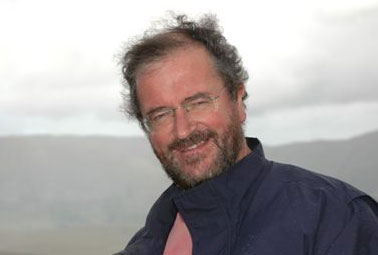
O’Donohue is the author of several books, including international bestsellers Anam Cara (Soul Friend) and Eternal Echoes, as well as two collections of poetry, Conamara Blues and Echoes of Memory. He also wrote a series of monogaphs: Stone as the Tabernacle of Memory; Fire as Home at the Hearth of the Spirit; Air as the Breath of God; and Water as the Tears of the Earth.
“Celtic sensibility and the Celtic imagination looked on nature not as ’stuff’ or ‘location’ or ‘matter,’” said O’Donohue, “but nature was the theatre of a variety and diversity of divine presences. One of the great cankers and severances of western tradition has been dualism, which separated mind from body, self from spirit, person from God and nature from the whole lot! The Celts, in some strange way, managed to preclude that kind of fissure/opening which would lead to dualism, and were able to think in a unitive consciousness and think of all these things together.”
His poem Beannacht (”Blessing”) is a beautiful prayer.
Joan Brown, OSF wrote an inspiring article for U.S. Catholic Magazine on the environment. It discussed the background and focus for her Ecology Ministry, and how love of creation has deep roots in our Catholic spiritual tradition. 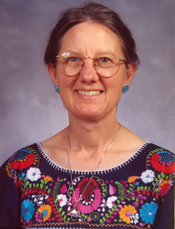
“One night when I was six years old, while walking outdoors before bed, I gazed at the sky and found myself wrapped in the vast mantle of stars, the Milky Way. Standing in awe, my body felt both small and large. In that instant I felt God.”
“The natural world has always taught us about God. Thirteenth-century mystic Meister Eckhardt said, ‘Creation is a revelation of God, a home for God, a temple for God.’ But with the growth of industrialization, technology, materialism, and consumerism, we have been lulled to sleep, forgetting who we are and our place on earth.”
“Our Catholic and Christian spiritual tradition-its saints, sacramentality, and practices-can help us to navigate this new challenge. In fact, the ecological crisis may very well lead us into a deeper relationship with God and help awaken us to the true meaning of life, which is loving all that exists.”
“Passionist Father Thomas Berry, the most influential Catholic eco-theologian, speaks of this time in history as a moment of grace, yet because of the urgency of this crisis, the transformation of our understanding of who we are must take place in a short period. Celebrating the wonders around us is part of our vocation to love and serve God and might very well be the path that can transform our lifestyles from consumerism to sustainability.”
Joan Brown directs efforts with the faith community through her work in Ecology Ministry. She is a Sister of the Rochester, Minnesota Franciscans; President of the Partnership for Earth Spirituality in Albuquerque, New Mexico; serves on the board of the National Catholic Rural Life Conference; Vice President of New Mexico Interfaith Power and Light (NMIPL) and chairs the NMIPL’s education committee.
Her work entails organizing, education, outreach, retreats and advocacy around water, climate change and sustainable living. Brown is the co-founder of Tierra Madre, a sustainable and self-help strawbale community for people of low income in Sunland Park, New Mexico.
Joan Brown, OSF is one of those people who makes you feel proud to be Catholic. Hers is a prophetic ministry for this century.
Shortly after New Year, my partner and I changed our whole diet. We went from pre-cooked food to eating mostly fresh vegetables. We both lost a lot of weight, but most importantly, our health and energy levels have improved. We feel better and look better. It all had to do with the food we ate.
Even going from prepared food, our weekly food bill has gone up. It costs a lot of money to eat healthy-and since “organic” may be a marketing strategy as well as a designation, I don’t necessarily buy organic products all the time. Even so, a shopping cart with mostly fresh produce and “green-friendly” items is pretty expensive.
This experience has gotten me started on thinking about food as a social justice issue. Can only the affluent afford to eat well? Is the only option for everyone else starch and fast food?
I did a little searching and found this article, “Organic Justice: Helping Poor People Buy Organic Food Directly from Farmers” on the Organic Consumers Association site.
The article provided other links to Just Food and Local Harvest, which help to direct people to local farms and CSA (Community Supported Agriculture) projects. Local Harvest described several ways poor people can purchase fresh produce, including the use of EBTs for payment and working with nonprofits where wealthier CSA members can help subsidize the weekly food baskets of others.
An innovative solution was developed by Crystine Goldberg of Uprising Farm in Washington State.
Goldberg and her partner Brian Campbell founded Uprising Organics Farm with two intentions: saving heirloom and open pollinated seeds, and getting good food to people regardless of income. After three seasons as market farmers, Goldberg and Campbell started a small CSA last year. It exclusively serves low income people, and the members pay with electronic food stamp benefits known as EBT.
Read more here.
The British group Catholic Concern for Animals has enlisted British TV chef Hugh Fearnley-Whittingstall and another celebrity chef, Jamie Oliver, to persuade the bishops of England and Wales to promote their dioceses as “free-range” users.
The animals rights group - whose members include Bishop Malcolm McMahon of Nottingham - wants all parish, rectory, school, convent and retreat centre dining halls to use only free-range poultry and eggs.
A talented writer, broadcaster and campaigner, Hugh Fearnley-Whittingstall is widely known for his commitment to seasonal, ethically produced food. His books, journalism and television series have earned him a huge popular following. He is also a strong supporter of the rights of local farmers and principals of fair trade.
Determined to start growing and rearing some of his own food, in 1998 Hugh started living in the original River Cottage farm in rural Dorset. His steep learning curve was documented in the Escape to River Cottage series (1999) which won him a big audience.
Originally a collection of mucky cow sheds, the property was transformed into a rustic, welcoming venue with a professional kitchen, thriving vegetable garden and small collection of livestock. It became the location for a range of River Cottage events and courses designed to promote the “grown your own” philosophy and provide an environment where people could dicuss, eat and learn about really good, well-produced food.


